Deer do more damage to landscape plantings in winter than in any other season, because the food they prefer is gone and they turn to whatever is still standing. In Chester County that usually means your foundation shrubs, your evergreens and the trees you planted in autumn.
Penn State Extension notes that Pennsylvania's deer population is increasing and that deer are now found regularly in densely populated areas. Anyone with a property backing onto woods near White Clay Creek, or on the wooded lots around Landenberg, already knows this. The question is not whether deer will visit. It is what they will reach first.
Why Deer Damage Peaks in Winter
Through spring and summer deer have abundant natural forage. By December that is gone. Penn State Extension points out that damage from white-tailed deer is most serious in the winter months, when their natural foods are limited.
What stays green and accessible through a Chester County winter is, unfortunately, exactly what sits around most homes: yews, arborvitae, rhododendrons, hollies and azaleas. A hungry herd can strip a mature foundation planting in a few nights, and a shrub browsed to bare wood often does not recover its shape for years, if at all.
Browsing and Rubbing Are Two Different Problems
They need different responses, and people often treat them as one.
Browsing
Deer have no upper front teeth, so they tear rather than cut. The damage looks ragged and torn, not clean. It stops at a clear height, usually around five to six feet, which is where the term browse line comes from. Once you see that straight horizontal edge across a hedge, the herd has been working the property for a while.
Buck rub
Bucks rub their antlers against trunks in autumn and early winter, stripping bark. Penn State Extension lists antler rubbing alongside browsing as a source of damage to landscape ornamentals. Rub damage is worse than it looks: bark removed around the full circumference of a young trunk kills the tree above that point, and there is no fix after the fact. Young, smooth-barked trees are the usual targets, which is why a newly planted tree can be lost in a single night.
What Deer Reach For First
Penn State Extension's guidance on gardening with deer identifies yews, rhododendrons, hostas and roses among the plants deer prefer. In practice, across properties in this area, the pattern holds: the newest, softest growth goes first, anything that stays green and reachable goes next, and plants with tough, aromatic or prickly foliage are left until the herd is desperate.
That last point carries the caveat every honest source includes. Deer-resistant is relative, not absolute. In a hard winter with heavy deer pressure, plants on every resistant list get eaten. Resistance buys you odds, not immunity.
What They Tend to Leave Alone
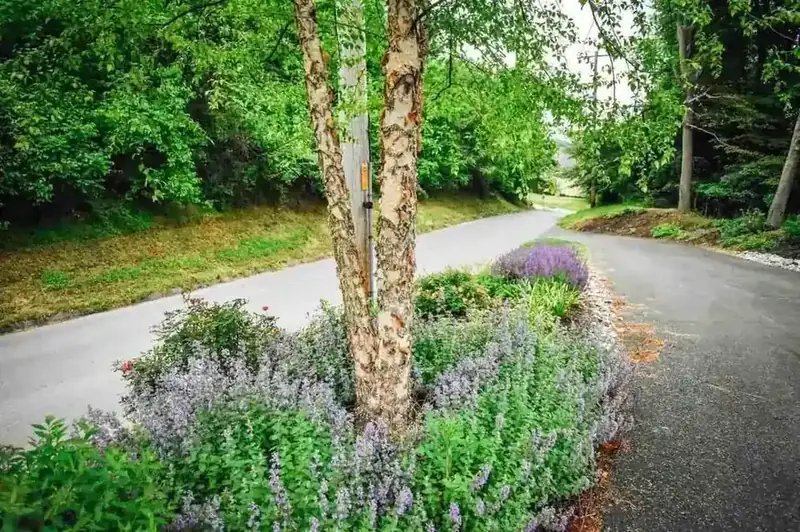
Plants deer avoid usually share characteristics rather than belonging to a family: strong aromatic oils, rough or hairy leaf surfaces, or spiny texture. Aromatic perennials such as catmint, ornamental grasses, and shrubs with tough or fragrant foliage generally come through winter in better shape than a yew hedge does.
This is a design decision as much as a plant decision. Where deer pressure is high, the plants most likely to be browsed belong away from woodland edges and deer trails, and the tougher material belongs on the perimeter. We plan plantings with species selection based on regional climate, soil conditions and long-term growth patterns, and on properties with real deer pressure that assessment includes what the herd will do to the design in January.
Protecting Plantings This Winter
If damage is already starting, four measures work.
- Trunk protection. Wrap or sleeve young, smooth-barked trees before rutting season to prevent antler rub. This is the single highest-value action, because rub damage cannot be repaired.
- Physical exclusion. Fencing or caging around high-value specimens is the only method that works reliably under heavy pressure. For individual shrubs, a cage is faster and cheaper than replacing the plant.
- Repellents, rotated. Repellents work until deer get used to them. Alternate products through the season and reapply after heavy rain or snow.
- Timing of pruning. Avoid cutting shrubs back into soft new growth late in the season, which puts tender material right at browse height. Our shrub and perennial pruning work follows species-specific timing for this reason.
The Long-Term Answer Is Design
Spraying every winter is a treadmill. Replanting browsed shrubs every spring is more expensive than planning around the problem once. On properties where deer pressure is a permanent condition, the durable fix is a landscape designed around it: resistant material in the exposed positions, protection built in for the specimens worth protecting, and the vulnerable plants kept close to the house where traffic discourages browsing.
If you planted trees or shrubs this autumn, those plantings are facing their first winter now. Protecting them this month is considerably cheaper than replacing them in April.
Talk to Pickel Landscape Group
Pickel Landscape Group has designed, planted and maintained landscapes across Chester County, PA and northern Delaware since 2007, including rural estates and wooded properties where deer pressure is constant. If your plantings are being browsed, request a consultation and we will assess the damage and the exposure before the worst of the winter.
Frequently Asked Questions About Winter Deer Damage
Last reviewed: November 2026
Related Articles
Why Fall Is the Best Time to Plant Trees and Shrubs in Chester County
Why fall is the best time to plant trees and shrubs in Chester County PA — cooler air, warm soil, and root establishment before winter.
Read morePlant This Fall, Bloom This Spring: A Guide to Bulb Installation in Chester County
Plant this fall, bloom this spring. Bulb installation in Chester County PA — layering, depths, and what full installation includes.
Read moreWinter-Proof Your Chester County Landscape
Prepare your Chester County landscape for winter with expert seasonal tips to protect your yard before the first frost.
Read more